Micro-Structural Analysis and Physicochemical Properties of 6A Grade Silk
1. Abstract
To examine the material characteristics of 6A grade mulberry silk, DOCSUN Silk Lab integrates scanning electron microscopy (SEM), digital optical microscopy, independent GTTC laboratory reports and a review of established biomedical literature. The following report focuses on fiber morphology, optical behavior, friction, hygroscopicity, electrostatic behavior and biological safety.
2. Microscopic Morphology (SEM Analysis)
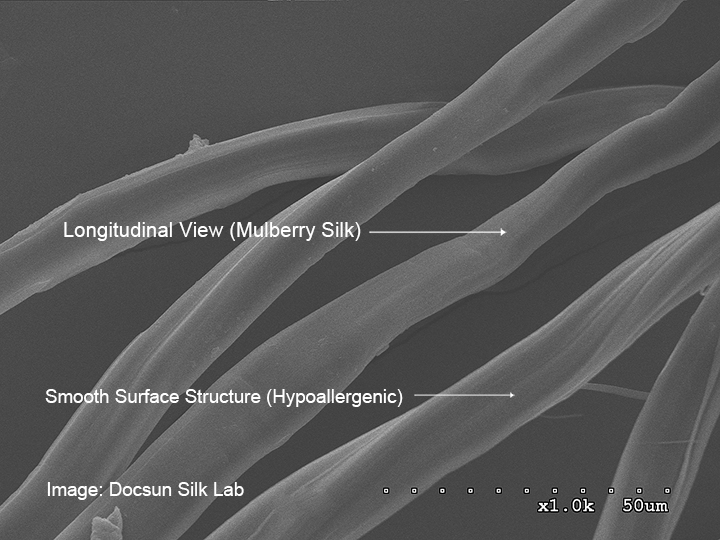
SEM observation allows the cross-sectional and longitudinal structure of silk fibroin to be examined at a scale that is not visible in ordinary product photography. The two views below help explain both the optical character and tactile profile of mulberry silk.
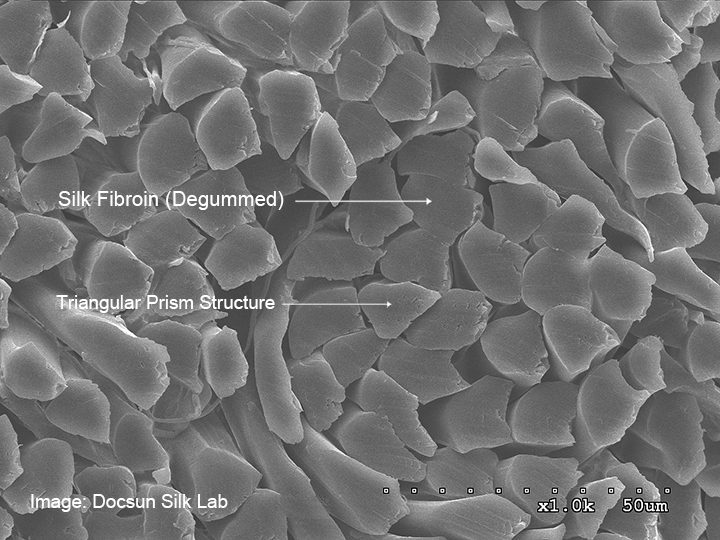
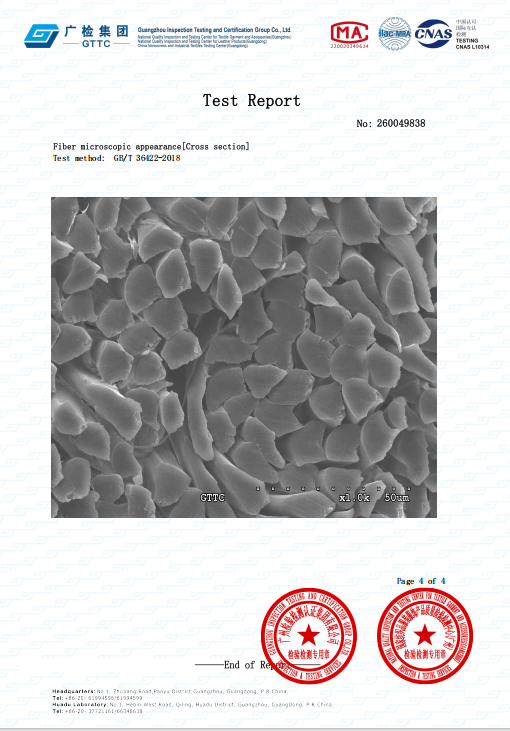
Optical refraction: The non-round cross-sectional geometry of silk behaves as a natural prism. Incoming light is refracted at multiple angles, contributing to the characteristic pearlescent luster of silk.
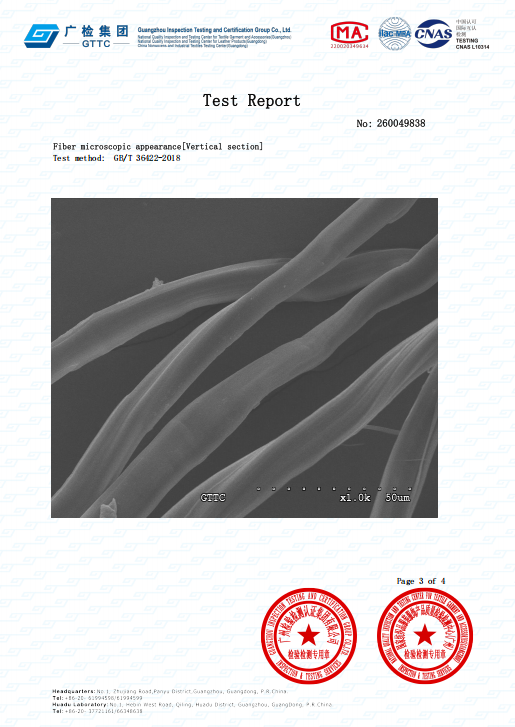
Surface topography: The longitudinal view shows a relatively smooth fiber surface, without wool-like scales or cotton-like convolutions. This morphology is relevant to friction and tactile smoothness.
3. Comparative Study I: Silk vs. Cotton
Cotton is also a natural fiber, but its morphology differs significantly from silk. Cotton fibers show a collapsed lumen and twisted ribbon-like surface, which affect moisture absorption, surface friction and visual finish.
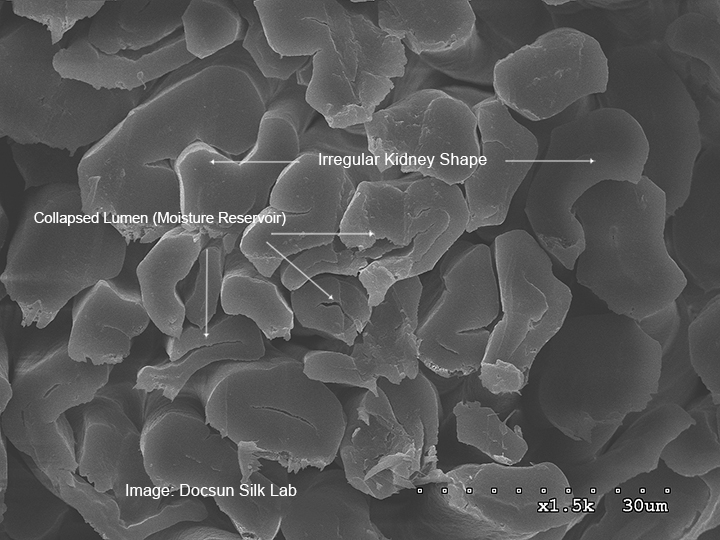
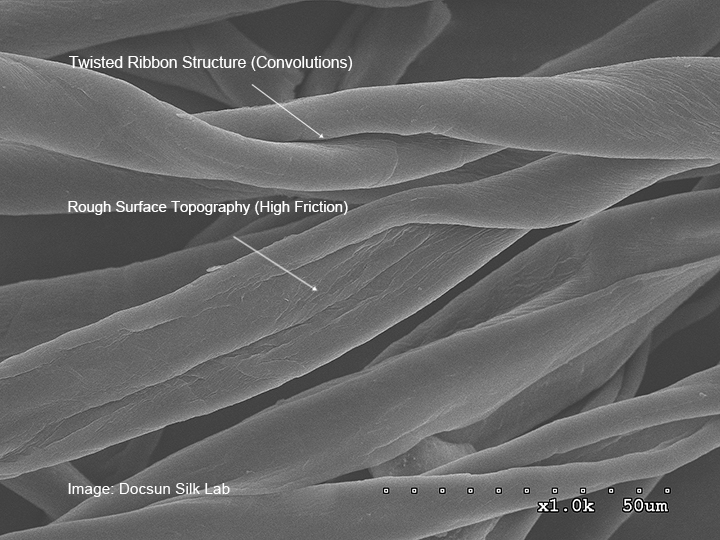
Analysis: Cotton's hollow lumen and twisted morphology increase hygroscopic behavior and surface irregularity. By contrast, silk's smoother and more compact structure helps explain its lower surface drag and different optical appearance.
4. Independent Laboratory Validation (GTTC)
The microstructural observations above are supported by physical samples submitted to Guangzhou Inspection Testing and Certification Group Co., Ltd. (GTTC), a CNAS-accredited testing authority with ilac-MRA mutual recognition.
100% Mulberry Silk - GTTC Test Report No. 260049838
Applicant: Docsun Home and Living Co., Ltd. | Test standard: GB/T 36422-2018 | Accreditation: CNAS L10314 | Report issue date: 2026-03-03.
100% Cotton - GTTC Test Report No. 260049836
Applicant: Docsun Home and Living Co., Ltd. | Test standard: GB/T 36422-2018 | Accreditation: CNAS L10314 | Report issue date: 2026-03-03.
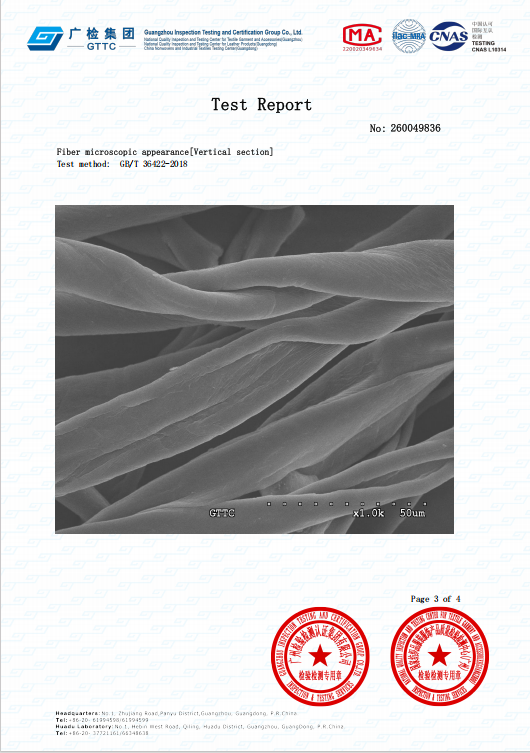
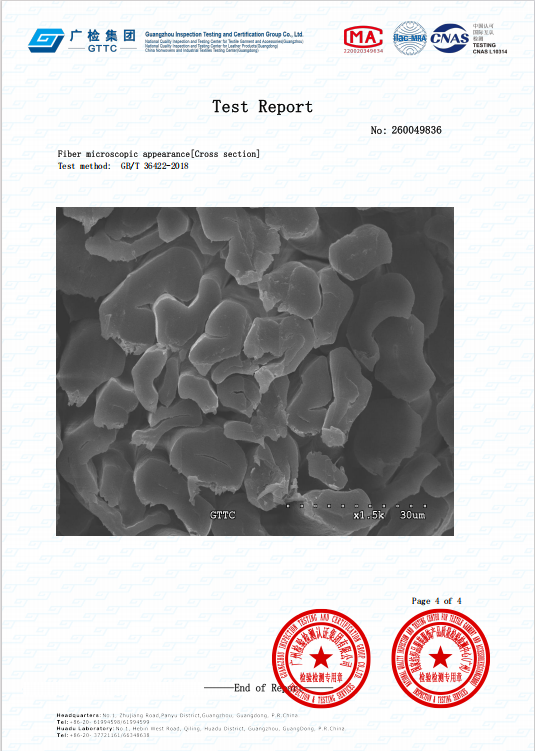
Test results are valid for the submitted samples under GTTC standard terms. Full reports may be requested for verification. Authenticity verification: Silk report code CMLI-6466-04; cotton report code HTSH-1021-44. Official portal: www.gttctech.com.
5. Comparative Study II: Silk vs. Polyester
SEM analysis reveals structural morphology, while digital optical microscopy helps visualize surface reflection and weave behavior. The following images compare natural mulberry silk with synthetic polyester satin.
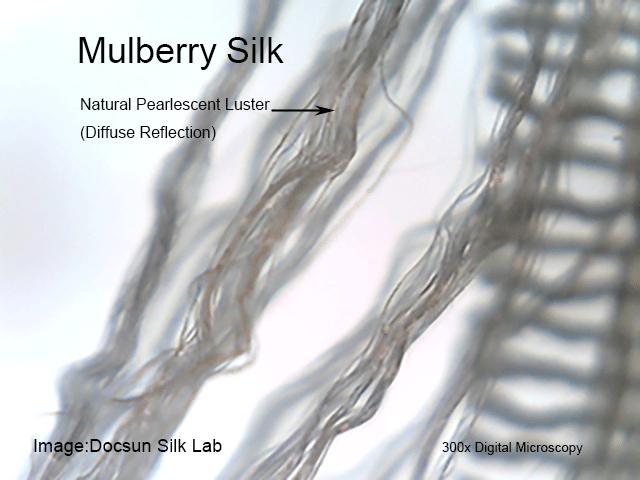
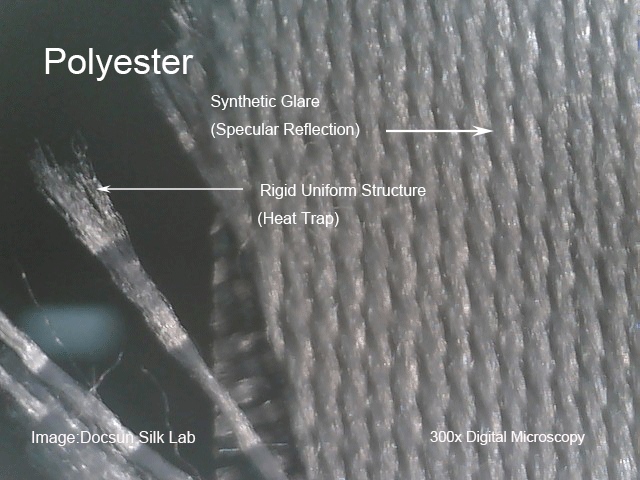
- Luster quality: Silk's irregular natural texture and triangular prism-like cross-section scatter light, while polyester's smoother synthetic surface reflects light more directly.
- Thermal and airflow behavior: The natural irregularity of silk fibers can support micro-scale air pathways, while mechanically uniform synthetic fibers tend to form a denser barrier.
6. Physical Properties: Friction, Hygroscopicity and Electrostatics
6.1 Tribology: Coefficient of Friction
The tactile smoothness of silk can be evaluated using tribological methods such as tribometers and atomic force microscopy (AFM). Literature on silk fibroin films reports nano-scale surface smoothness and substantial friction reduction under hydrated conditions.
Nano-scale smoothness: De Giorgio et al. (2024) report that regenerated silk fibroin films can exhibit surface roughness (Ra) below 10 nm, reducing sliding resistance at the contact interface[2].
Hydration lubrication: Under hydrated conditions, silk fibroin can form a water-mediated lubrication layer, with reported coefficient of friction values as low as 0.02-0.10 in selected test conditions[1].
| Test Subject | Friction Coefficient Range | Performance Benchmark |
|---|---|---|
| Silk fibroin film vs. glass - dry | 0.25-0.40 | Moderate protective coating behavior |
| Silk fibroin film vs. glass - hydrated | 0.02-0.10 | Reported as approaching biological lubrication conditions |
| Silk fibroin suture vs. tissue | 30%-50% lower than cotton in selected contexts | Lower tissue abrasion profile |
| Nanofiber surface roughness (Ra) | < 10 nm | Nano-scale smooth interface |
6.2 Electrostatics and Hygroscopicity
Synthetic materials such as polyester are prone to static accumulation because of low moisture regain. In contrast, natural fibers such as silk and cotton contain hydrophilic groups that can bind water molecules and support charge dissipation.
According to Jain et al. (2023) and Hutton et al. (1949), silk fibroin contains polar amino acids and nano-pores that attract water molecules through hydrogen bonding[3][4]. This intrinsic hydration contributes to electrostatic balance under daily contact conditions.
| Material | Moisture Regain | Electrostatic Potential | Key Factors |
|---|---|---|---|
| Mulberry silk fibroin | Approx. 11% (reported range 10%-30%) | Approx. 100-200 mV under daily light friction; approx. 1-2 kV in high-intensity tests | Hydrophilic amino acid groups and nano-pores support moisture absorption and charge dissipation. |
| Cotton | Approx. 8.5% | Approx. 55-60 mV under daily light friction; below 1.5 kV in high-intensity tests | Abundant hydroxyl groups provide strong hydrophilicity and rapid charge leakage. |
| Polyester | Approx. 0.4% | Approx. 240-270 mV under daily light friction; above 3.6 kV in high-intensity tests | Low moisture absorption prevents effective charge dissipation, allowing static accumulation. |
Note: Low-pressure tests at mV level more closely simulate daily light friction such as fabric-to-skin contact. High-intensity kV tests simulate laboratory rotary friction conditions[6].
7. Biological Safety: Immunogenicity and Clinical Validation
Scientific literature generally attributes the immunogenic potential of raw silk primarily to sericin. After degumming, the remaining silk fibroin is widely studied as a biocompatible material in biomedical contexts.
- Biomaterial classification: Silk fibroin has been used in surgical sutures and tissue scaffolds, and is discussed in biomedical literature as a clinically relevant material[2].
- Low inflammatory response: Purified silk fibroin is reported to induce limited inflammatory cytokine release compared with sericin-containing samples in selected studies[2].
- Cell viability: In vitro studies report high cell viability on silk fibroin substrates, supporting its biocompatibility in controlled test conditions.
Repair-oriented immune response: De Giorgio et al. (2024) discuss silk fibroin scaffolds in relation to immune microenvironment modulation, including pathways associated with M2 macrophage polarization in tissue repair contexts.
Metabolic safety: Silk fibroin can be enzymatically degraded into amino acid components, avoiding some degradation pathways associated with synthetic polymers.
8. Frontier Applications: Silk in Regenerative Medicine and Technology
Beyond textiles, silk fibroin is being studied as a foundational biomaterial for regenerative medicine, bioelectronics and smart textile systems. The research directions below are included to contextualize why silk is considered a high-value natural protein material.
8.1 Bone Tissue Engineering
Li et al. (2022) review silk fibroin scaffolds for bone tissue engineering, noting mechanical support from beta-sheet crystalline regions and the potential to support bone marrow stromal cell behavior[7].
8.2 Transient Bioelectronics
In organic bioelectronics, silk fibroin is valued for optical transparency, dielectric properties and biodegradability. Researchers are exploring transient sensors that can dissolve after completing their function[2][3].
8.3 Meniscal and Soft Tissue Replacement
Warnecke et al. (2017) reported friction behavior of silk fibroin scaffolds for meniscal replacement, including lubrication performance under biologically relevant conditions[1].
8.4 Moisture-Responsive Smart Textiles
Jia et al. (2019) demonstrated moisture-sensitive behavior in silk fiber systems, opening research directions for humidity-responsive textile structures[5].
9. Scientific References
- Warnecke, D., et al. "Friction properties of a new silk fibroin scaffold for meniscal replacement." Tribology International 107 (2017).
- De Giorgio, G., et al. "Silk Fibroin Materials: Biomedical Applications and Perspectives." Bioengineering 11.2 (2024).
- Jain, S., et al. "Silk and its composites for humidity and gas sensing applications." Frontiers in Chemistry 11 (2023).
- Hutton, E. A., et al. "The Moisture Regain of Silk: Adsorption and Desorption of Water by Silk at 25 degrees C." Textile Research Journal (1949).
- Jia, et al. "Moisture Sensitive Smart Yarns and Textiles from Self-Balanced Silk Fiber Muscles." Advanced Functional Materials (2019).
- "Electrostatic Properties of Clothing Fabrics Suitable for Different End-Uses." ResearchGate (2020).
- Li, M., et al. "A Comprehensive Review on Silk Fibroin as a Persuasive Biomaterial for Bone Tissue Engineering." International Journal of Molecular Sciences 23 (2022).
10. Frequently Asked Questions
Why does 6A grade silk have a pearlescent luster?
How does the microscopic structure of silk differ from cotton?
Is silk fibroin scientifically considered biocompatible?
Why do natural fibers usually generate less static electricity than polyester?
From Lab to Living Room
The material observations above help explain why 6A grade mulberry silk is used in skin-contact home textiles such as pillowcases.
Explore Products Engineered with 6A Silk